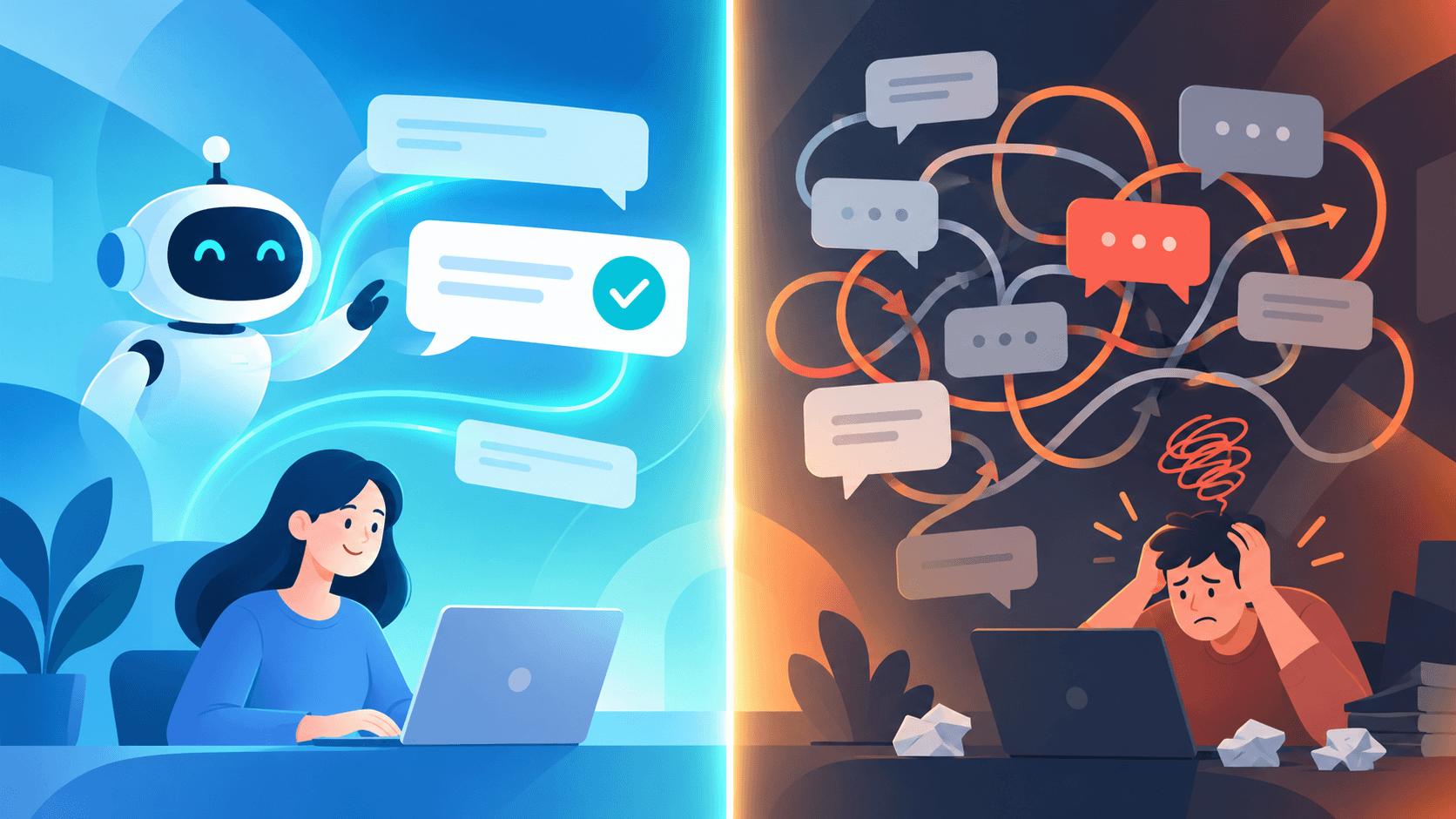
There's a wide gap in AI customer support performance depending on how it's implemented. AI chatbots with action-taking capability resolve 60-80% of customer inquiries without human involvement, while older rule-based chatbots achieve only 20-35%. Yet at the same time, a significant share of users still don't find AI genuinely helpful. The line between "convenient" and "frustrating" comes down to how the system is designed and governed, not simply whether AI is used.
Where AI Genuinely Helps
The gap between 60-80% and 20-35% doesn't come from AI being "smarter", it comes from the ability to act: a chatbot that can look up an order, process a refund, or update account information resolves issues far more completely than one that only follows a fixed script and then redirects the user to look things up manually.
Where the Line Starts
Problems emerge when customer expectations exceed what the system can actually deliver. 76% of customers expect companies to understand their needs and context without having to repeat information, a very high bar that many AI systems still fail to meet. Nearly one in five consumers (around 20%) see no benefit at all from AI in customer service interactions. One in three agents (33%) handle interactions without sufficient customer context, leading to disjointed, impersonal experiences.
The Real Risk: Hallucination and Reputational Damage
22% of businesses have had to roll back a live AI agent due to hallucination, meaning the AI gave incorrect or fabricated information. When asked about the most serious consequence of an AI agent failure, 34% of businesses named "reputational damage" as the biggest impact, ranking it above direct financial loss. Notably, 74% of surveyed organizations admitted to having experienced at least one serious AI-related escalation incident.
But this same data reveals a clear divide between well-governed and poorly-governed businesses: organizations classified as having "mature safeguards" (structured control and oversight mechanisms for AI) made up 81% of the group experiencing the fewest serious incidents. In other words, the risk isn't from using AI, it's from whether adequate investment has been made in control mechanisms.
When Done Right, the Payoff Is Substantial
Real-world case studies show the potential when AI is well implemented and governed. Klarna handles 1.3 million customer conversations per month with AI, equivalent to the workload of roughly 800 full-time staff. Cisco Webex, after improving system design for one enterprise customer, helped reduce human escalation rates by as much as 85%. This is evidence that when the system is built correctly, operational scale can grow dramatically without sacrificing customer experience.
Principles to Take Away
Based on this data, a few principles stand out for deploying AI customer support: prioritize chatbots with genuine action-taking capability rather than just scripted responses; invest in guardrails to reduce hallucination, since reputational consequences can outweigh technical costs; ensure the system carries enough customer context so people don't have to repeat themselves; and track escalation rates and their root causes as an operational health metric, rather than treating every escalation as a failure.
In the end, the line between convenience and frustration comes down to how seriously a business invests in AI governance, not whether it uses AI at all.